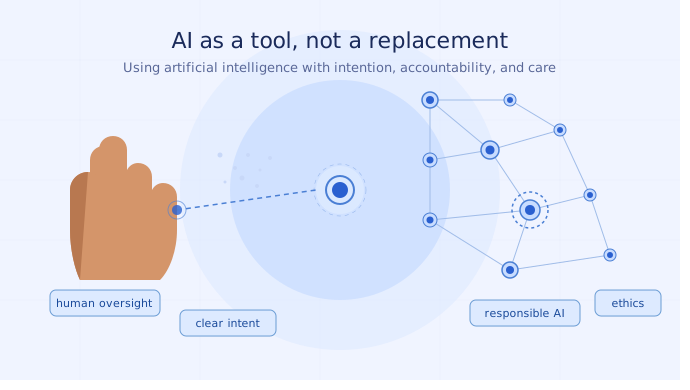
If you have gotten the impression that I am an AI hater, you got me totally wrong. I preach caution, due diligence, and purposeful, planned usage.
What irks me is talking about AI as our supreme leader, throwing caution to the wind, and giving every AI agent and chatbot on the planet unrestricted, unfettered access to absolutely everything, YOLO-style. I am strongly opposed to this type of AI use; it’s both irresponsible and dangerous. So I speak out against the hype that encourages this kind of reckless usage.
I know going against the hype and refusing to drink the Kool-Aid makes me decidedly un-cool. I’m OK with that. I’ve never been one of the cool kids, and I’ve never been one for drinking the Kool-Aid and just going with the flow, when going with the flow was against my better judgment. Back in the days, kids were being bullied for being geeks because they were into computers, because that wasn’t mainstream. Now, folks are being bullied for not being reckless with AI use.
I am, though, very much in favor of planned and purposeful AI use when it makes sense.
It’s like hiring an incredibly efficient and bright intern or executive assistant, who saw his first computer six months ago when he started college. Then, decide to give him the keys to the kingdom and let him run the whole company. I don’t care how efficient and bright this kid was; anyone who proposed this plan would be labeled certifiably insane and likely fired on the spot.
Today’s AI agents are helpful assistants, nothing more. For more details on the capabilities of today’s AI, check out https://securenet.is/thoughts-on-artificial-intelligence/
The principle of least access still applies. Just like you have a job description and a plan before you hire a new person, you should have an AI plan that outlines exactly what you plan to use it for, what access that entails, etc., and then only provision that exact access. Make sure the access is appropriate for a junior person.
Also, always proofread anything created by AI, including validating all citations, facts, and figures. You can have AI perform first-level editing of a document (basically an advanced spell/grammar checker), but a human should always do the final proofreading. This applies whether we are talking about business documents, presentations, or code reviews.
Even the AI agrees with this. I was just having a lovely chat with my friend Claude (the one from Antropic, not some French dude) about which tools I should use for proofreading. He recommended some advanced spell-checkers and then told me to make sure a human reviews anything business-critical. He asked for usage- and scenario-based details to hone his recommendations, which I provided. Then I grilled him on the reasoning behind those recommendations and pressed him to see if any others were equally good or better. He kept returning to his original recommendations and provided solid reasoning for them. He also gave solid reasons why a human proofreader was critical for business-critical text. Not once in this rather lengthy discussion did he even hint at having him proofread anything, even though I’m sure he would if I asked.
The point here, again, is purposeful and intentional use where it makes sense. Even in this age of AI, using the right tool for the right job is still critical. A heavy screwdriver can drive a nail into the wall, but it’s not the best tool for the job.